Far East Fiber's 2 Billion RMB Bet on AI Data Center Fiber: A Signal for ODN Equipment Suppliers
By Jergeo Engineering Team | July 28, 2026 · Based on SSE filing 上证上审(再融资)〔2026〕219号

On July 27, 2026, Far East Fiber (远东股份, SSE: 600869) announced that the Shanghai Stock Exchange has formally accepted its application for a 2 billion RMB (approximately $277 million USD) capital raise. The funds are earmarked for an "AIDC Full-Synthesis Fiber Preform Rod Manufacturing Project" and working capital supplementation. This isn't just another corporate financing announcement — it's a clear market signal that the AI data center fiber infrastructure boom is accelerating, not plateauing.
Summary
Far East Fiber's $2B preform expansion will ease global fiber supply constraints, supporting more AI data center builds that require high-port-count ODFs and fiber distribution infrastructure.
The Capacity Leap: 300 → 800 → 2100 Tons
According to Far East Fiber's July 22 investor communication, the company's expansion roadmap is aggressive:
- Current capacity: 300 tons/year fiber preform rod, plus 10 million fiber-kilometers of drawn fiber annually
- 2026 target: 800 tons/year preform rod, with supporting production of specialty fibers including hollow-core fiber, polarization-maintaining (PM) fiber, and MPO high-speed jumpers
- 2027 target: 2100 tons/year preform rod — a 7x increase from current capacity in just 18 months
This isn't linear growth. It's exponential scaling, and it's being funded by a capital raise that has already passed all regulatory approvals (environmental assessment, energy assessment, safety assessment). The project is already under construction.
Vertical Integration: From Preform Rod to MPO Jumpers
What makes Far East Fiber's strategy particularly noteworthy is the vertical integration play. The company isn't just expanding preform rod capacity — it's building a complete supply chain from raw material to finished connector assemblies:
Supply Chain Architecture:
Fiber Preform Rod → Fiber Drawing → Specialty Fiber (PM/Hollow-Core) → MPO/MTP Pre-Terminated Jumpers
When a single manufacturer controls the entire chain from preform to jumper, it reduces lead times, ensures quality consistency, and — critically for data center operators — provides a single source of accountability for high-density fiber connectivity solutions.
Far East Fiber's data center fiber shipments are already 80% focused on AIDC applications, with products including G657.A1, G657.A2, and polarization-maintaining fiber. The company is positioning itself as a "solution provider" rather than a component supplier.
Why This Matters for ODN Equipment Manufacturers
Fiber preform rod is the raw material for fiber optic cables. When upstream manufacturers expand preform capacity, it directly increases downstream fiber deployment volumes. More fiber in data centers means more fiber connections that need to be organized, protected, and managed — which is exactly what ODN (Optical Distribution Network) equipment does.
The demand chain is straightforward:
- More preform rod capacity → more fiber drawn → more fiber deployed in data centers
- More fiber deployed → more fiber distribution cabinets (FDC) needed to terminate and organize cables
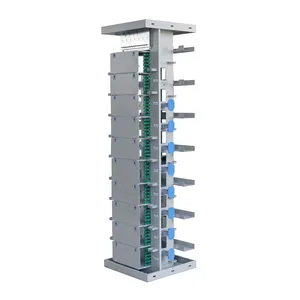
- Higher fiber density per rack → more optical distribution frames (ODF) and patch panels required, with higher port counts per unit
- More complex fiber routing → increased demand for splice closures, cable management systems, and structured cabling infrastructure
ODN Equipment Demand Drivers
Unlike fiber itself (whose prices have surged 300-400% due to supply constraints), ODN equipment — fiber distribution cabinets, patch panels, ODFs, splice closures — are sheet metal products. Their raw material costs (steel, aluminum) remain relatively stable, making ODN equipment a cost-predictable component of AI data center infrastructure budgets even as fiber prices spike.
Key ODN procurement trends emerging from AIDC construction:
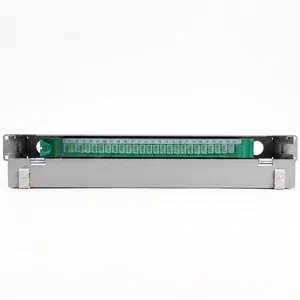
- Higher port density: Buyers are specifying 96-144 port panels in 1U form factors, up from traditional 12-48 port configurations. AI training cluster racks require 96-192 fiber ports, compared to 12-48 ports in enterprise data centers.
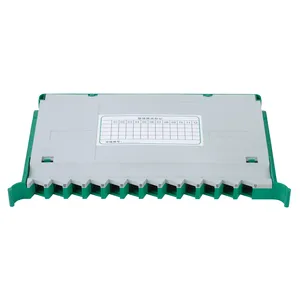
- Mixed connector environments: CPO (Co-Packaged Optics) and traditional architectures coexist in the same facility, requiring panels that support LC, SC, and MPO adapters in a single chassis.
- Front-access maintenance: AI data centers with rear cooling infrastructure need sliding or rotary ODF designs that allow front-access maintenance without disturbing rear cable pathways.
- Modular scalability: Data center operators prefer modular ODN solutions that can be deployed incrementally as fiber demand grows, rather than over-provisioning upfront.
The Broader Context: AI Infrastructure Investment Acceleration
Far East Fiber's 2 billion RMB raise is part of a larger pattern of AI infrastructure investment that's reshaping the fiber optic industry. Earlier this month, reports emerged that NVIDIA is quietly acquiring dark fiber resources across North America, with a 3-year investment budget of $5-10 billion USD. The company is also making direct investments in optical component manufacturers (Coherent, Lumentum) totaling $4 billion USD.
Meanwhile, industry data from CRU (UK-based commodity research) shows that China's effective fiber preform utilization rate is expected to reach 84.3% in 2026, with capacity approaching full utilization. Multiple manufacturers have announced expansion plans, but demand growth is outpacing supply additions.
At the 2026 World Artificial Intelligence Conference (WAIC), YOFC President Zhuang Dan stated that data center fiber demand — historically less than 10% of total optical connectivity demand — is projected to exceed 50% by 2030. Polarization-maintaining fiber demand alone is expected to grow 10-20x in the next 1-2 years, driven by CPO architecture adoption.
What This Means for Procurement Teams
For data center operators and hyperscalers planning AI infrastructure deployments, the upstream capacity expansion signals two things:
- Fiber supply will improve — as new preform capacity comes online in 2026-2027, the supply-demand gap that has driven fiber price increases should narrow. This could stabilize fiber costs, though prices are unlikely to return to pre-AI levels.
- ODN infrastructure planning is critical now — even as fiber supply improves, the passive infrastructure that organizes and manages that fiber (cabinets, patch panels, ODFs) requires longer lead times for specification, procurement, and installation. Data center operators should engage ODN equipment suppliers early in the design phase to ensure compatibility with high-density fiber architectures.
The fiber optic industry is undergoing a structural transition. Growth is no longer driven by telecom carriers building FTTH networks — it's driven by hyperscalers and AI labs building training clusters. For every participant in the ODN supply chain, the question is no longer whether AI will drive demand, but how quickly the market will scale to meet it.
Related Products
Sources
This article is based on Far East Fiber (远东股份, SSE: 600869) official announcements filed July 27, 2026 (上证上审(再融资)〔2026〕219号) and investor communication records from July 22, 2026. Market data from CRU 2026–2031 optical cable market report and public remarks at WAIC 2026. Filing available at Shanghai Stock Exchange. Additional coverage at Light Reading.