FTTH Network

From apartment blocks to mountain villages — last-mile fiber, done right

Three FTTH scenarios, three deployment architectures, one product line. Whether it is a 10,000-unit residential complex, a 50-story commercial tower, or a 200-household village 20km from the nearest CO — the right architecture and product selection make the difference between a network that works and one that does not.

Solution 01

Residential Community FTTH

The most common FTTH scenario: 2,000–10,000 households across 20–50 buildings. Four-tier architecture from community cabinet to in-home terminal, with standardized products at every layer.
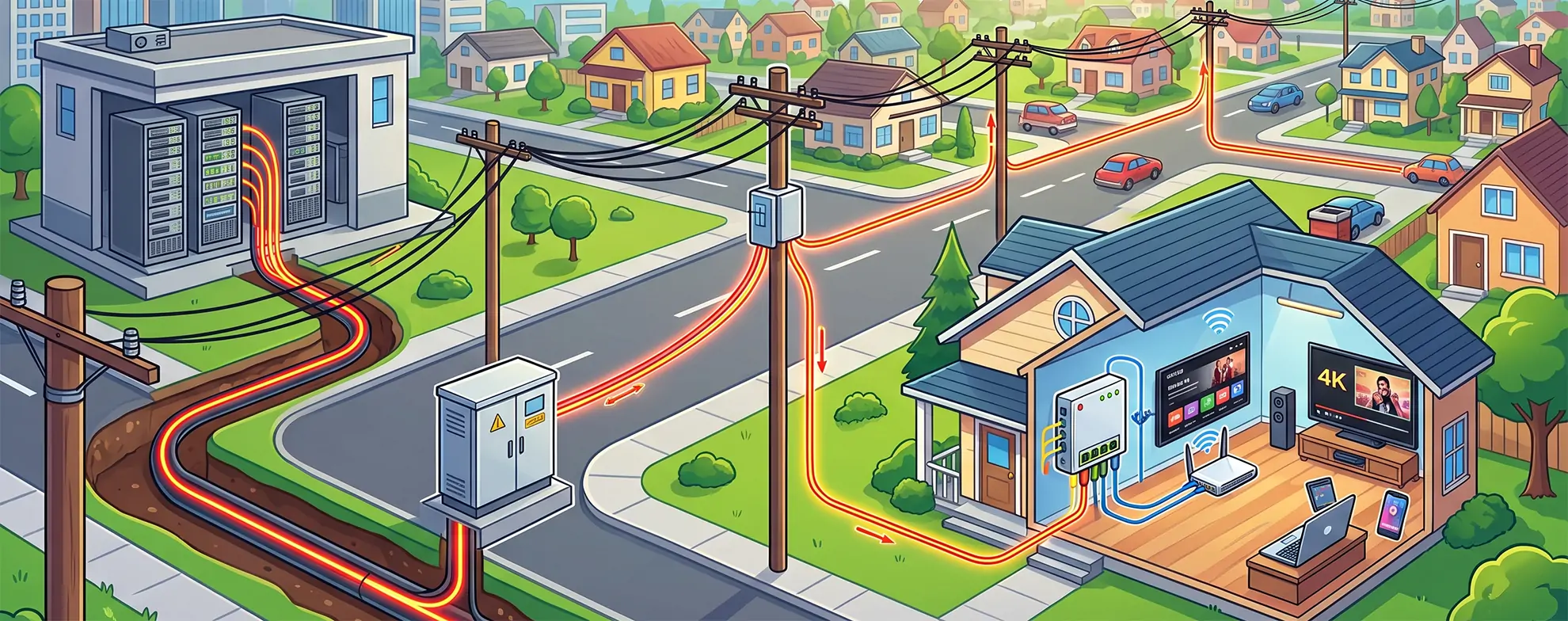
Residential community FTTH deployment with fiber distribution cabinets, outdoor telecom cabinets, and fiber termination boxes for 2000-10000 household neighborhoods

Four-tier architecture

1
Community Cabinet
Outdoor Telecom Cabinet
144–288 fibers, IP65
2
Building Distribution
Fiber Distribution Cabinet
24–48 fibers, wall-mount
3
Floor Box
Fiber Distribution Box
4–8 ports, IP65
4
In-Home Terminal
Optical Terminal Box
2–4 fibers, SC adapter

What this solves

Compact FDB designs fit existing risers. G.657 bend-insensitive fiber handles tight corners.
Tight conduit and riser space in old buildings
Standardized port layout and labeling across all tiers. Optional RFID tags for electronic tracking.
Thousands of subscribers, no unified management
Modular design: swap floor boxes and splitters without touching the riser backbone.
Upgrading means re-cabling occupied apartments
IP65 distribution cabinets, IP67 floor boxes. SMC material resists corrosion and UV.
Humid stairwells and dusty equipment rooms
Solution 02

High-Rise Vertical Fiber Cabling

A 50-story tower is not just a tall apartment building. The riser shaft carries hundreds of fibers in a space shared with power, fire, and security systems. Vertical cabling needs multi-stage splitting, fire-rated components, and a backbone you will never need to replace.

Vertical split architecture

MDF (B1/F1)
Optical Distribution Frame
144–1152 fibers, 19" rack
IDA (every 5–10F)
Fiber Patch Panel
24–48 fibers, 4U–6U
Riser (every 3–5F)
Fiber Splice Closure
96–288 cores, IP54+
Floor (each floor)
Fiber Distribution Box
8–24 ports, wall-mount

Optical power budget (50-story example)

MDF → Riser backbone
50m ≤1.5dB
Per-floor branch cable
5m ≤0.5dB
Floor distribution
20m ≤0.4dB
Drop to unit
30m ≤0.5dB
Total (worst case)
≤200m ≤4.5dB

Fire-Rated Materials

Enclosure materials meet UL94 V-0 flammability rating, suitable for indoor vertical riser installations per building code requirements.

Pre-terminated Backbone

Factory-spliced riser cables arrive on reels. Pull, plug, test. Riser installation in hours, not days.

Splitter Strategy

1:32/64 at MDF, 1:8/16 at IDA, 1:4 at floor. Balanced power budget at every tier.

Solution 03

Rural & Remote Area FTTH Coverage

50–300 households spread across 5–20 km². No reliable power, no sheltered equipment rooms, and every truck roll costs a day. This solution prioritizes solar power, IP67+ protection, and zero-maintenance design over everything else.

Cabinet material selection for rural conditions

Material Weight Corrosion Cost Best For
SMC Light (~1.9g/cm³) Excellent (1000h salt spray) Medium Coastal / humid / acid rain
Galvanized Steel Medium Good (periodic maintenance) Lower Inland, general environment
304 Stainless Steel Heavy (~7.9g/cm³) Outstanding Higher Industrial / extreme corrosion

Rural-specific design considerations

Solar Power Option
Cabinets with integrated solar panels and battery backup for sites without grid power.
IP67/IP68 Standard
Every outdoor component rated for continuous exposure. No sheltered locations required.
Lightning Protection
Grounded metallic enclosures, SPD on cable entries, and gas discharge tubes on fiber ports.
Long-Distance Reach
G.657.b3 low-bend-loss fiber + optimized split ratios support 20km+ without repeaters.
Anti-Theft Hardware
Three-point locks, tamper-proof hinges, and optional GPS tracking for high-risk locations.
Remote Monitoring
Optional temperature, humidity, and intrusion sensors with 4G/NB-IoT backhaul.

Tell us your FTTH scenario

Building type, subscriber count, distance from CO, environment conditions — share your project details and we will recommend the right architecture and product mix within 1 hour.


Frequently Asked Questions

What is the difference between FTTH and FTTB fiber deployment?
FTTH (Fiber to the Home) brings fiber directly to each subscriber living unit, delivering the highest bandwidth with an optical terminal box inside the home. FTTB (Fiber to the Building) terminates fiber at the building MDF room, using existing copper or LAN cabling for the last hop to each unit. FTTH provides symmetrical gigabit speeds and lower latency, while FTTB offers lower deployment cost in buildings where in-home fiber routing is impractical. FTTH is the preferred long-term architecture for new construction.
What equipment do I need for a complete FTTH network?
A full FTTH network requires equipment at four tiers: the community cabinet (Outdoor Telecom Cabinet, 144-288 fibers, IP65), building distribution (Fiber Distribution Cabinet, 24-48 fibers, wall-mount), floor-level distribution (Fiber Distribution Box, 4-8 ports, IP65), and in-home termination (Optical Terminal Box, 2-4 fibers, SC adapter). You also need splitters, pre-terminated cable assemblies, and splice closures for the backbone. Jergeo provides all layers as a unified product family.
How do I select the right fiber splitter for my FTTH network?
Splitter selection depends on your deployment architecture and optical power budget. PLC (Planar Lightwave Circuit) splitters are standard for FTTH due to uniform loss across all output ports and a compact form factor. Use 1:32 splitters for standard residential density, 1:64 for high-density urban areas, and 1:128 for rural long-reach scenarios. For high-rise buildings, a cascaded strategy (1:32 at MDF, 1:8 at IDA, 1:4 at floor) balances the power budget across all vertical tiers.
Can outdoor fiber terminal boxes be installed in extreme weather conditions?
Yes. Jergeo outdoor terminal boxes are rated IP65 to IP68 and operate from -40 to +70 degrees C. SMC enclosures provide natural corrosion resistance for coastal and acid-rain zones without requiring grounding. For underground or flood-prone installations, IP67/IP68 models with FKM seals are tested for extended submersion. Lightning protection with 10 kA or more withstand rating and SPD on cable entries safeguards equipment in storm-prone areas. Optional remote monitoring sensors provide real-time temperature and intrusion alerts.